






The Government of Ghana is calling for stronger cooperation among policymakers, financial institutions, academia, and private operators to tackle deep-rooted challenges in the country’s transport sector.
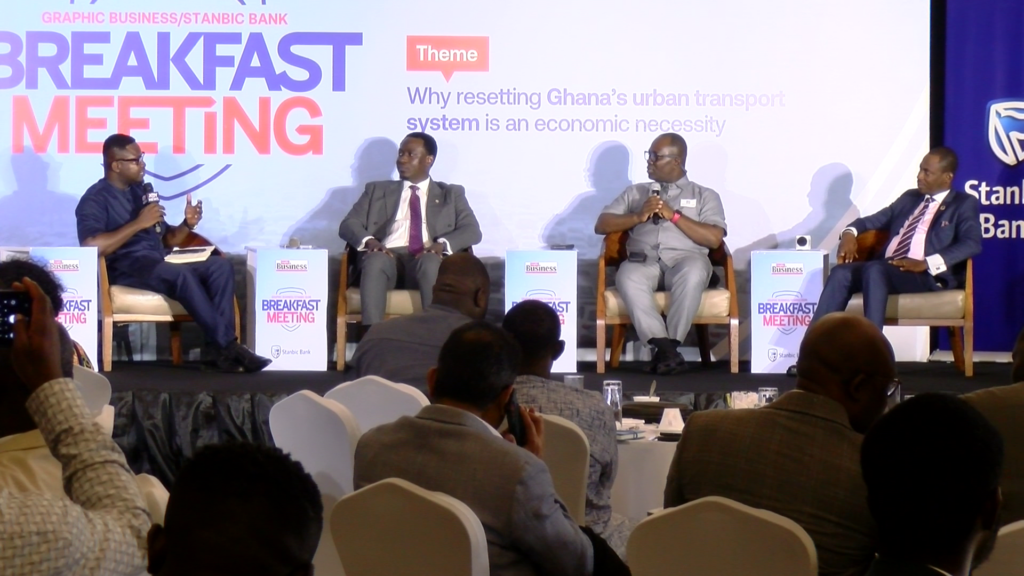
Speaking at the Graphic Business and Stanbic Bank Ghana Breakfast Meeting, Eric Tetteh-Addison, Director of Policy Planning at the Ministry of Transport, highlighted the need for a coordinated, multi-faceted approach to address congestion, inefficiencies, and inadequate service delivery.
“To solve congestion, it must be a multifaceted approach. The transport system is made up of infrastructure, vehicles, and load. If the vehicles are available but the infrastructure is inadequate, demand will exceed supply. That is where you begin to see shortages and chaos within the system,” he said.
Focus on Service Delivery and Mass Transit
Mr. Tetteh-Addison emphasised that while road expansion falls under other ministries, the Transport Ministry is prioritising effective and efficient service delivery within existing infrastructure.
He illustrated the impact of high occupancy buses:
“If instead you have three high occupancy buses in the same space carrying 80 to 100 people each, you are moving more than 300 people at a go and freeing up road space for others.”
He also disclosed plans to expand alternative transport modes. A revised Legislative Instrument (LI) before Parliament will require vehicle owners to register with towing companies to ensure broken-down vehicles are cleared promptly, reinforcing road discipline and safety.
“Road transport has dominated the space in Ghana for too long. Rail is not functioning as it should, and water transport is virtually absent. We are studying how to use coastal waters and improve movement on the Volta Lake so we are not relying only on roads,” he added.
Financial Collaboration and Integrity
Mawuko Afadzinu, Executive Head of Business and Marketing at Stanbic Bank Ghana, reflected on the collapse of a $50 million revolving transport financing scheme introduced in 2007 due to loan defaults.
“The vision was that beneficiaries would pay 10 percent upfront, complete payment within four years, and the money would revolve to finance more buses. Over time, Ghana would have had thousands of new vehicles financed through a self-sustaining scheme. There were huge defaults,” he explained.
He stressed that restoring trust and integrity in financial agreements is critical for sustaining collaborative models.
“If we increase our sense of integrity and respect for process, if we take a loan, agree to the terms, and do whatever it takes to repay, we can change this country. Without that systemic mindset shift, it is difficult to bring such a model back.”
Academia Advocates Data-Driven Reforms
From the academic sector, Professor Enoch F. Sam, Director of Research, Innovation and Development at the University of Education, Winneba, called for data-driven solutions to inform transport reforms.
“The first thing is to understand how our people move, how they commute, and for what reasons. With that understanding, we can determine the most efficient ways of moving them,” he said.
He emphasised multi-modal transport and behavioural change to reduce congestion:
“We are overly focused on roads. Some bulk goods should move by rail or water. That will free space for daily commuting activities. Clear hawkers off the roads and provide them with appropriate spaces. Make public transport more efficient by moving people in mass numbers.”
Professor Sam also advocated integrating trotros as feeder services to high-capacity buses rather than eliminating them abruptly, noting that Ghana has the policies but lacks proper implementation.
Shared Responsibility for Sustainable Transport
Stakeholders concluded that tackling Ghana’s transport challenges requires:
-
Stronger collaboration among regulators, financiers, operators, and commuters
-
Disciplined, data-driven implementation of policies
-
Commitment to shared responsibility and integrity in financial and operational systems
The government, through the Ministry of Transport, aims to set the tone, but sustained partnerships and systemic reforms will be essential to ease congestion and improve economic efficiency.
Source: Accra Business News
Disclaimer: Some content on Accra Business News may be aggregated, summarized, or edited from third-party sources for informational purposes. Images and media are used under fair use or royalty-free licenses. Accra Business News, an extension of Accra Street Journal is a subsidiary of SamBoad Publishing Ltd under SamBoad Holdings Ltd, registered in Ghana since 2014.
For concerns or inquiries, please visit our Privacy Policy or Contact Page.
📢 GET FREE JOBS + TIPS
Others are getting instant job updates and career tips on our WhatsApp Channel. Why miss out?
📲 Join SamBoad Jobs Channel Now